August 21, 2026
·
Updated September 5, 2026
·
12 min read
Best Telegram-Based Live Chat Widgets for 2026
A curated collection of Telegram-based live chat widgets for 2026—compare setup speed, team workflows, automation depth, context/lead capture, compliance, and real total cost so you can pick the right website-to-Telegram chat stack.

If your team already lives in Telegram, forcing every website conversation into yet another support dashboard can feel like unnecessary friction. The hard part isn’t “adding chat”—it’s choosing a setup that fits your workflow, captures the right context, and doesn’t create new compliance or maintenance headaches.
This collection breaks down the leading Telegram-based approaches: lightweight widgets, helpdesk integrations, and automation-first builders. You’ll get a clear comparison, an implementation reality check, and a decision rubric to match each option to your site stack, lead-capture needs, and how you actually respond to customers.
Choose What Matters
Before you compare tools, decide what “good” looks like for your site and team. Telegram-based widgets fail in predictable ways: replies don’t thread cleanly, notifications drop, or context disappears. Pick criteria first, or you’ll buy convenience and inherit chaos.
Eloqra is strong when your priority is a true reply-from-Telegram workflow plus a simple, single-script install. Other tools can still win if you need a formal helpdesk, strict compliance controls, or deeper CRM automation.
Telegram workflow fit
Your core risk is thinking “it’s Telegram” automatically means you can run support from Telegram. Many setups forward messages one-way, break threading, or rely on flaky bot delivery.
Decide upfront: you need two-way replies from Telegram, a shared inbox pattern if multiple people answer, and notifications you can trust when you’re offline.
If you can’t confidently reply from Telegram every time, it’s not a Telegram workflow.
Website install scope
Install friction becomes ongoing friction, especially across multiple sites or client projects.
- Single script snippet, no build step
- Works with Next.js and SSR
- Works with Webflow, WordPress, HTML
- Minimal performance overhead
- Easy to remove or disable
If install needs engineering time, you’ll postpone it and lose leads.
Data and context
Telegram alone doesn’t tell you what the visitor was doing when they messaged you.
- Current page URL
- Device type
- Browser details
- Country or region
- Transcript retention controls
Without context, you’ll ask obvious questions and slow every conversation.
Lead capture needs
Decide whether you want a pre-chat form before you even see the first message. It can improve follow-up, but it can also add friction and raise privacy expectations.
If you sell higher-consideration services, name and email capture can be worth it. If you optimize for “ask fast, reply fast,” keep it optional and lightweight.
The best default is choice: let you toggle it per site or page.
Compliance and security
Telegram makes messaging easy, not automatically compliant for your use case. Your real risk is collecting personal data without clear consent, retention rules, or access controls.
Confirm how the widget handles consent, what data is stored outside Telegram, and how you secure the bot and admin settings. Also check whether you can control retention, deletion, and exports.
If you can’t explain your data flow in two minutes, you’re not ready to deploy.
Total cost reality
Pricing surprises usually come from seats, channels, or “required” add-ons.
| Cost factor | What to check | Surprise to avoid | Best for |
|---|---|---|---|
| Pricing model | Flat vs per-seat | Seat creep | Small teams |
| Per-seat limits | Agents and roles | Paywall for access | Support shifts |
| Bot hosting | Included or DIY | Extra infra work | Dev-led teams |
| Add-ons | CRM, automation, branding | Mandatory upgrades | Growing orgs |
If you want low overhead, pick the tool whose default plan already fits.
Best for Fast Setup
Fast setup matters when you want to ship a widget today and answer from your phone. These picks avoid backend work, keep the embed simple, and still give you enough context to reply well.
Eloqra
If you want a widget that behaves like “Telegram, but on your site,” prioritize the install path. A single script snippet and a two-way Telegram inbox keeps the overhead low.
You paste one script and start receiving messages in Telegram. You reply there, with visitor context like page, device, browser, and country. Add an optional pre-chat form when you need name and email, and skip it when you don’t. It also plays nicely with most stacks, from Next.js to Webflow, WordPress, and plain HTML.
That combination is hard to beat when speed and simplicity are the whole point.
ChatBro
ChatBro is worth a look when you want chat plus community vibes. It’s less about support workflows, more about keeping conversations visible and active.
You embed it like a typical widget, and Telegram is one of the supported chat options depending on how you configure it. Where it shines is group-style chat, channels, and “many people talking” patterns that feel more like a forum. That can be useful for product communities, events, or live streams.
Pick it when your problem is participation, not ticket-like support.
Bothelp Widget
If your “chat” is really lead capture with automation, Telegram-first tools can move faster than a full helpdesk.
Bothelp Widget
- Capture leads into Telegram conversations
- Auto-reply with scripted qualifying questions
- Route prospects by tags or rules
- Trigger simple follow-ups and reminders
- Connect basic sales or support flows
Use it when you want fewer live chats and more structured conversion paths.
Crisp + Telegram
Sometimes you need Telegram, but you also need a real shared inbox. That’s where a helpdesk-style tool with Telegram as a channel can make sense.
Crisp can plug Telegram in alongside email and other channels, then add assignments, internal notes, and team visibility. The tradeoff is extra setup and more time in a dashboard, because Telegram is just one lane in a bigger system.
Choose this route when coordination beats speed.
For an example of how a helpdesk-style inbox connects Telegram (and the kinds of caveats you’ll run into), see tawk.to’s guide on connecting your Telegram bot.
Best for Teams
When you have multiple agents, “Telegram-first” quickly turns into “ops-first.” You need routing, ownership, history, and reporting that survive handoffs.
These tools can outperform Telegram-only flows on collaboration and auditability, but you’ll trade simplicity for process.
Intercom + Telegram
Intercom is built for high-volume support and lifecycle messaging, with strong automation, routing, and reporting. Add Telegram and you get another entry point, but you also add moving parts and policy decisions.
Expect real workflow power: assignment rules, team inbox controls, macros, and conversation intelligence. The tradeoff is integration complexity and a heavier admin footprint than a simple widget.
Pick this when you need enterprise-grade operations more than a “reply from Telegram” experience.
Zendesk + Telegram
Zendesk shines when chat must become tickets, with SLAs, approvals, and clean audit trails. Telegram can be a useful front door, but you’ll usually route messages into Zendesk to enforce process.
You get deep ticketing primitives: statuses, queues, triggers, views, and compliance-friendly history. You’ll pay for that rigor in setup time, seat costs, and ongoing tuning.
If you’re measured on SLA adherence and traceability, this is the kind of stack that holds up under scrutiny.
Freshdesk + Telegram
Freshdesk is a solid mid-market helpdesk when you want team workflows without enterprise overhead. It plays well in multi-channel setups where Telegram is only one of several inputs.
- Use shared inboxes with assignment and collision detection
- Route by group, topic, or business hours
- Track history with notes and internal replies
- Expand beyond Telegram into email and web chat
- Keep reporting simple but useful
If your pain is coordination, not customization, this strikes a practical balance.
Tawk.to + bridge
Tawk.to is a low-cost live chat widget that covers the basics for real-time website conversations. To involve Telegram, teams often rely on a bridge or connector that forwards messages.
That can work well for simple “ping me on Telegram” needs, but reliability depends on the bridge and its maintenance. When something breaks, debugging usually lands on you.
Use this when budget is tight and you can tolerate some integration babysitting.

Best for Automation
Automation is where Telegram can shine, because bots are native to the platform and fast to deploy. The tradeoff is feel: bots and integrations can drift away from a “website live chat” experience unless you’re deliberate about handoff and context.
If you need a widget-first setup with Telegram as the inbox, Eloqra keeps the web install simple while still supporting qualification basics like visitor context and optional pre-chat capture. Automation-first stacks below go deeper on bot logic, but usually ask for more wiring and monitoring.
ManyChat
ManyChat is built for flows: menus, qualification questions, tagging, and branching logic that routes people to the right next step. It can work well when your “chat” starts automated, then hands off to a human only after intent is clear.
Plan and channel constraints matter. Depending on your setup, the website widget experience and Telegram behaviors can differ, so test the exact handoff path you’ll rely on.
If your first priority is structured automation over a pure live-chat feel, ManyChat earns its place.
Chatfuel
Chatfuel is strong when you want to build a Telegram bot quickly, especially for scripted FAQs, lead capture, and simple routing. It’s a good fit when Telegram is the primary channel and the website is mostly a traffic source.
The limitation is the “live chat widget” illusion. A bot-first experience can feel like a redirect into Telegram rather than an on-site conversation with rich visitor context.
Pick Chatfuel when bot speed matters more than widget polish.
Make or Zapier
Use automation glue when you need routing, logging, and alerts across tools, with Telegram as the notification and reply channel.
Make or Zapier
Use automation glue when you need routing, logging, and alerts across tools, with Telegram as the notification and reply channel.
- Trigger on a new chat event from your widget or form.
- Enrich the lead in your CRM with page and UTM data.
- Route to the right agent channel based on rules.
- Send a Telegram alert with the full context.
- Create a fallback path when the scenario fails.
Watch for silent failures, because missed messages look like “no leads,” not “broken automation.”
If you’re using Zapier, note Telegram’s trigger constraints in Zapier’s docs on getting started with Telegram.
Custom bot build
Build a custom bot when your routing rules are unique, your data must stay in a specific place, or your CRM needs deep two-way sync. It’s also the right move when you want complete control over identity, permissions, and audit trails.
The cost is ongoing maintenance. Telegram API changes, hosting, retries, spam controls, and edge cases will become part of your support load.
If you can’t describe the long-term owner, don’t start the build.
Side-by-Side Comparison
You’re choosing between “Telegram-first” chat widgets and broader helpdesk suites with Telegram as one channel. Compare what matters on your site: install effort, whether you can actually handle replies end-to-end in Telegram, and the context you get with each message (especially if you’re trying to keep your support stack lightweight).
| Option | Reply from Telegram | Install on website | Visitor context | Best for |
|---|---|---|---|---|
| Eloqra | Yes | Single script | Page, device, country | Fast Telegram-first chat without a dashboard |
| Chatra | No (app/desk) | Script snippet | Basic visitor info | Classic live chat UI |
| Crisp | Partial (inbox) | Script snippet | Strong profiles | Multi-channel support |
| Tawk.to | No (app/desk) | Script snippet | Basic visitor details | Free chat + agents |
| Intercom | Partial (inbox) | Script + config | Deep targeting | Product-led support |
If your priority is replying straight from Telegram with minimal setup and still getting the key “who/where” context on each message, the Telegram-first approach tends to map more cleanly to that workflow than suites where Telegram is just one more channel.
Implementation Reality Check
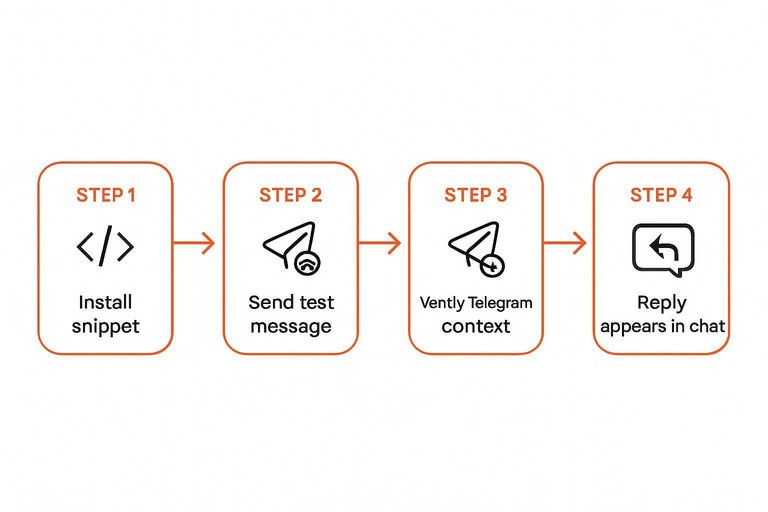
You’re not done when the widget renders. You’re done when a real visitor message lands in Telegram, and your reply returns to the browser.
- Install the snippet on one page first, then hard-refresh and confirm it loads once.
- Send a test message from a clean session, like an incognito window.
- Verify the message arrives in Telegram with visitor context, like page and device.
- Reply from Telegram and confirm the reply appears in the site chat thread.
- Repeat on a second stack page, like Next.js and Webflow, to catch script-order issues.
If step four fails, you don’t have “chat.” You have a live chat vs contact form choice with a costume.
Two-Way Delivery Troubleshooting Checklist
When messages only go one way (or vanish), it’s usually one of these predictable breakpoints. Run this checklist in order—don’t change five things at once.
-
Bot linking & operator identity
-
Confirm you completed the Telegram linking flow in the widget’s dashboard/console.
-
Send a test message and verify it lands in the same Telegram account (and correct group/chat) you plan to reply from.
-
If you use a group, ensure the bot is actually in the group and you’re replying in the right thread/chat.
-
Reply path (Telegram → browser) is enabled
-
Reply to the test message directly from Telegram (not by starting a fresh chat with the bot).
-
If you have multiple sites/inboxes, confirm you’re replying to the correct conversation so the widget can map the reply back to the right visitor thread.
-
Script placement & load order
-
Ensure the snippet is present only once (duplicate installs can produce “it renders but doesn’t route” behavior).
-
Place it in a shared layout (e.g., global header/footer) so it loads on every page where you expect replies to appear.
-
If your stack hydrates/rerenders (e.g., SPA routes), confirm the widget isn’t being torn down/reinitialized on navigation.
-
Browser blocking (ads/privacy/extensions)
-
Test with extensions disabled and in an incognito/private window.
-
If your site has a strict Content Security Policy (CSP), make sure it allows the widget script and any required connections; otherwise the UI may render partially while messaging fails.
-
Threading/session mismatch
-
Keep the visitor tab open while testing replies; many widgets tie delivery to an active session.
-
Don’t mix test runs across multiple tabs/devices at once—start with a single incognito session so the “reply goes to the wrong thread” symptom is obvious.
If the widget renders but step four (reply returning to the browser) still fails after this checklist, you’re not dealing with “setup”—you’re dealing with a broken two-way routing path that needs a targeted fix, not more styling tweaks.
Where Others Win
If your needs go past a Telegram-first, lightweight widget, other tools can fit better. You’ll usually trade simplicity for deeper workflows, compliance, or richer omnichannel support.
- Intercom — Best for product-led SaaS needing in-app automation and segmentation.
- Zendesk — Best for ticketing-first orgs with SLAs, queues, and audit trails.
- Freshdesk — Best for teams that want helpdesk basics with structured escalation.
- Crisp — Best for shared inbox + knowledge base + campaigns in one place.
- Chatwoot (self-hosted) — Best for teams needing control over data and deployments.
Pick these when process and scale matter more than a single-script Telegram inbox like Eloqra.
Decision Rubric
Use this rubric to make a final pick without overthinking it.
Score each option against your support model, your stack, and your compliance constraints.
| Decision factor | What to check | Best fit if… | Top picks |
|---|---|---|---|
| Reply workflow | Reply inside Telegram? | You live on mobile | Eloqra, Telegram bot setup |
| Install effort | Single script snippet? | You want no backend | Eloqra, Crisp |
| Site compatibility | Works on Webflow/WP/HTML? | You ship across stacks | Eloqra, Crisp |
| Visitor context | Page, device, country? | You triage fast | Eloqra, Crisp |
| Lead capture | Optional pre-chat form? | You need emails too | Eloqra, Tawk.to |
| Team features | Roles, routing, SLAs? | You run support ops | Intercom, Zendesk |
| Budget + scope | Free tier vs suites | You want lightweight | Eloqra, Tawk.to |
| Compliance needs | Data controls, DPA, exports | You’re in regulated work | Zendesk, Intercom |
If you want Telegram replies plus a single-script install, Eloqra is the clean default; pick a suite when process matters more than speed.
Pick Your Default, Then Make One Exception
For most solo founders, small SaaS teams, and agencies that want Telegram-first support without extra tooling, Eloqra is the clean default: a single script install, two-way replies from Telegram, and useful visitor context (page, device, browser, country) with optional pre-chat lead capture. Choose Intercom/Zendesk/Freshdesk if you need shared inbox rigor, SLAs, roles, and reporting; go ManyChat/Chatfuel (or Make/Zapier) when automation and routing matter more than “live chat” simplicity; and use Crisp + Telegram or a lightweight bridge when you want a broader chat platform with Telegram as one channel. If you’re torn, decide based on where you’ll spend time: in Telegram replying fast, in a helpdesk managing a team, or in automations designing flows.
Turn Telegram Into Live Chat
After comparing widgets and scoring tradeoffs, the real test is how quickly you can deploy, stay responsive, and keep context without extra dashboards.
Eloqra routes every website message straight to your Telegram with a lightweight widget and one-script install—claim the Free Forever plan to get live in minutes.
Written by
Eloqra
Notes from the Eloqra team on collecting testimonials and building authentic social proof.
Share: